
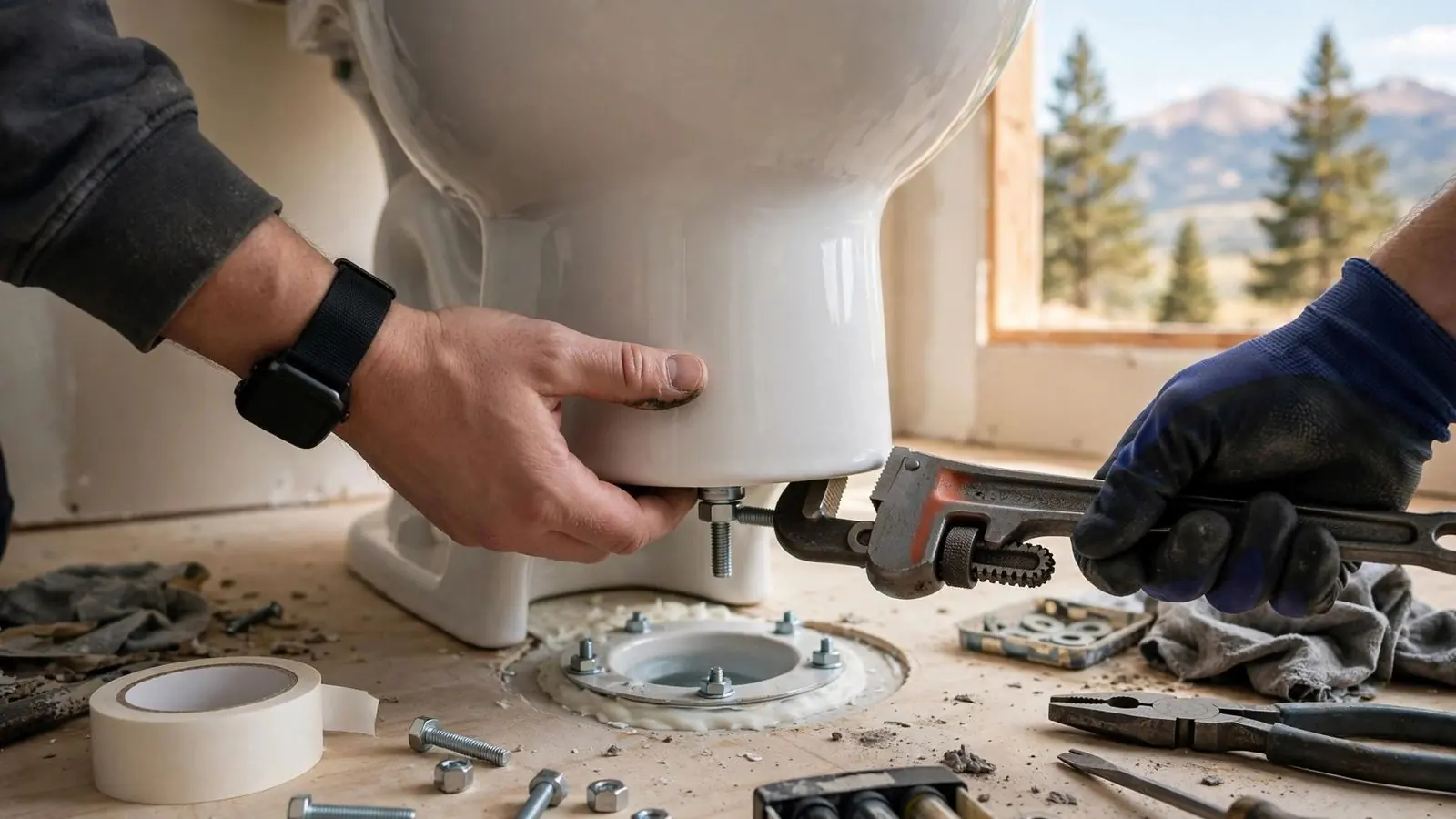
A two piece toilet has a separate tank and bowl, which makes it easier to carry and install than a one piece model. The job is straightforward when the floor flange is sound and the new toilet matches the rough-in distance. Most surprises come from a damaged flange, a rotted floor or a toilet that does not fit the space.
This guide covers the steps, the measurement to take before you buy and the signs that call for a plumber. If you would rather not do the work, see toilet repair and installation.
Measure before you shop
The rough-in is the distance from the wall behind the toilet to the center of the floor drain. The most common size is twelve inches, though ten and fourteen exist. A toilet built for the wrong rough-in will not fit. Measure from the finished wall, not the baseboard, to the center of the closet bolts.
Also check the space on each side and in front of the toilet, and the height of the seat if anyone in the home has trouble sitting or standing.
Installation steps
Shut off water and drain the tank before you begin:
- Disconnect the supply line and remove the old tank and bowl, keeping track of the bolts.
- Scrape the old wax from the flange and inspect the flange for cracks or rust.
- Set a new wax ring on the flange or on the bottom of the bowl, following the instructions.
- Lower the bowl straight down onto the bolts and press evenly, then check that it is level.
- Tighten the nuts a little at a time, alternating sides, to avoid cracking the china.
- Attach the tank to the bowl with the new gasket and bolts.
- Connect the supply line, open the valve, flush several times and check for leaks.
Problems that call for a plumber
Stop if you find:
- A flange that is cracked, corroded or below the finished floor.
- A soft or stained floor around the base.
- A toilet that rocks even after shimming.
- A supply valve that will not close or leaks.
- Water that returns after the first week.
Southlake homes and the age of the flange
Southlake grew from about 7,000 residents to more than 21,000 as the city developed after the early 1990s, which means many homes are now 25 to 35 years old. Flanges and closet bolts of that age can be corroded or loose, even when the toilet looks fine from above.
Inspect the flange every time you pull a toilet. If a floor was retiled over the years, the flange may now sit below the tile surface, which causes leaks, and a spacer or a new flange fixes it.
Source type: City of Southlake growth figures and plumbing practice.
Two piece versus one piece
Two piece toilets are common and easier to move. One piece toilets are easier to clean and have fewer seams, but they are heavier. Either type works. Choose by the rough-in, the bowl shape, the height and the flushing performance, not by the look alone. Look for models with a larger flush valve, which helps clear waste in a single flush.
If your old toilet clogged often, a newer design may help. If it still clogs, the problem may be in the line, which is covered in drain cleaning.
After the install
Follow the manufacturer's installation guidelines for bolt torque and wax ring type, and do not overtighten the bolts. Caulk the base only along the sides and front, leaving the back open if you want to see a leak. Run the toilet for a day and recheck. Keep the manual for the flush valve size so replacement parts are easy to buy.
Shimming and leveling
If the floor is uneven, the toilet will rock. Use plastic shims to level it, then trim them flush and seal around the base. Do not tighten the bolts to compensate for a rocking toilet, because that cracks the china. A toilet that still rocks after shimming may sit on a floor that has settled or a flange that is too low.
A level toilet also reduces stress on the wax ring, which is the part that keeps sewer gas and water out of your bathroom.
Disposal of the old toilet
A toilet is heavy and awkward. Wrap it, lift with your legs and ask for help. Many waste companies take old toilets only on special pickup days, and some recycling centers accept porcelain. If you hire us, we remove and dispose of the old unit as part of the job. Ask any installer whether removal is included.
Cover the open flange with a rag while the toilet is out, since sewer gas escapes through it and a dropped tool can fall into the pipe.
One last check
Before you call the job done, rock the toilet gently, flush five times and look underneath for any moisture. Check again after a day. A slow seep at the base is easier to fix right away than after it has stained the floor.
Want a plumber to install the toilet? Call to schedule.
Call (817) 601-6266Two piece toilet questions
About an hour or two when the flange and floor are sound.
Buy a toilet made for your rough-in. Adapters are a poor fix.
No. Always use a new one.
Many were built after the early 1990s as the city grew, so original flanges and valves are now decades old.
Yes, see Keller.