
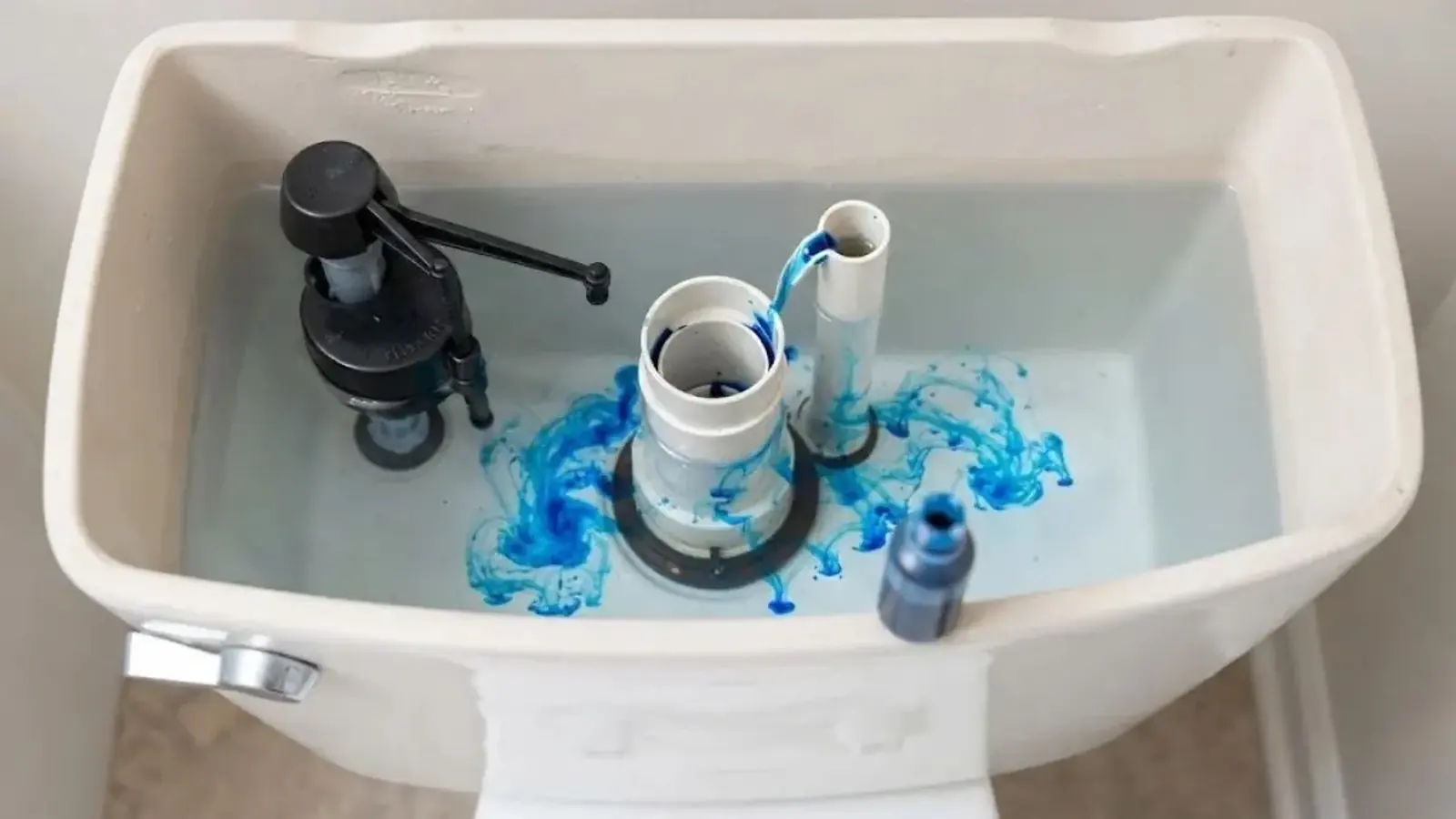
A toilet leaks in two ways. Water can slip from the tank into the bowl past a worn flapper, or it can seep out at the base or the supply connection. The first is silent and wastes the most water. The second can rot a floor. Three simple tests find either one in under half an hour and need nothing but food coloring, a dry paper towel and your water meter.
If any test points to a leak you cannot fix, our leak detection team finds the source without opening walls blindly. If the toilet itself is the problem, see toilet repair and installation.
Three tests, in order
Do them in this order:
- Dye test: put ten drops of food coloring in the tank, wait fifteen minutes without flushing and look for color in the bowl.
- Base test: dry the floor around the toilet, press a paper towel around the base and supply line and check for dampness after a flush.
- Meter test: close every faucet and appliance, note the meter reading and check again after thirty minutes without using water.
What each test tells you
Read the results here.
| Result | Meaning | Next step |
|---|---|---|
| Color in the bowl | Flapper or seat leaking | Replace the flapper |
| Damp paper at the base | Wax ring or bolts failing | Reset the toilet with a new wax ring |
| Damp supply connection | Loose or worn connector | Tighten or replace the line |
| Meter moves with everything off | A leak somewhere | Isolate by closing the toilet valve and rechecking |
If the meter stops moving once the toilet valve is closed, the toilet is the leak.
The meter check, straight from the city
According to the City of Southlake, residents should check the water meter with every faucet closed. If the meter shows flow, you may have a leak. The city's guidance gives you a free first step before you call anyone.
Most meter lids have a small low-flow indicator, often a dial or triangle that spins even with a tiny leak. Watch it for a minute with everything off. If it turns, close the valve behind each toilet one at a time and watch again. When the dial stops, you found the leaking fixture.
Source type: City of Southlake water utility guidance.
Signs that point to the base
A toilet that rocks, a floor that feels soft near the base, discolored caulk or a musty smell are all signs of a leak at the wax ring or the closet flange. Water that seeps under the toilet may travel under flooring and show up elsewhere. Do not ignore a damp floor, because moisture and wood rot together.
If the floor is soft, stop using the toilet and call. A plumber can reset the toilet and tell you whether the subfloor needs attention.
When the leak is not the toilet
If the meter test shows a leak and the toilet is dry, the source may be elsewhere: a faucet, a water heater, an irrigation line or a pipe in the slab. Hidden leaks under a slab show up as warm spots on the floor, the sound of rushing water or a bill that climbs without explanation. Our slab leak repair page explains what to expect.
Irrigation leaks are common in Texas yards. Shut the irrigation supply and recheck the meter to rule them in or out.
Getting it fixed
A new flapper and a wax ring are inexpensive, but only if the diagnosis is right. A leak you cannot find costs more over time. If you are in Keller or Southlake and the tests are inconclusive, call and we will check with the right tools.
Silent leaks and your bill
A flapper leak can waste water around the clock without a sound. If your bill rises with no change in habits, test the toilets first, since they are the most common hidden leak in a home. Check every toilet, including guest bathrooms that rarely get used. A rarely used toilet can leak for months before anyone notices.
Compare two or three months of bills if you have them. A steady rise with no explanation is a reason to run the meter test.
Why a small leak matters
A leak of a few drops a second looks harmless, but it adds up to thousands of gallons in a month. Beyond the bill, constant flow wears parts and can hide a developing problem at the shutoff valve or the supply line. Fixing it early costs a few dollars in parts. Waiting can mean a ruined floor.
If you are unsure, our leak detection page explains what a technician does with acoustic and pressure tools.
Cannot find the leak? Call for leak detection.
Call (817) 601-6266Toilet leak questions
Yes. A flapper leak into the bowl is often silent and shows up only on the meter or the bill.
About ten drops is enough. Wait fifteen minutes without flushing.
It advises checking the water meter with all faucets closed, and treating any movement as a possible leak.
Not always, but it can damage the floor. Close the valve and call if water is spreading.
Yes. The line is open 24/7.