
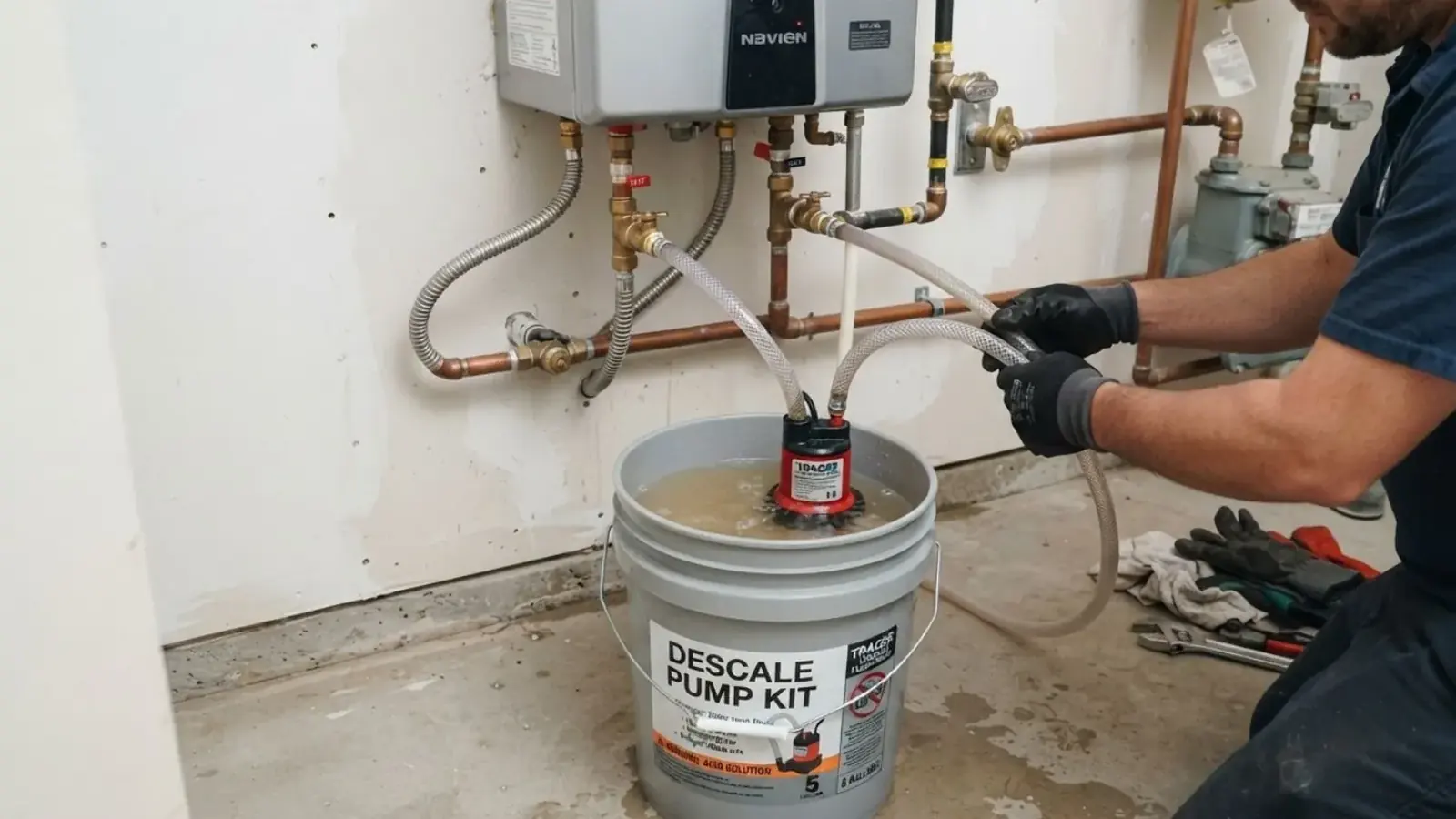
Flushing a tankless water heater removes scale from the heat exchanger. In an area with moderately hard water, scale builds quietly and shows up as lower flow, slower hot water and error codes. A flush takes about an hour and needs a small pump, two hoses and a descaling solution. Many units have service valves that make it easy.
This guide gives the steps and a schedule. If your unit has no service valves, or you are not comfortable working with gas or electric appliances, call our tankless water heater team.
What you need
Gather these:
- A small submersible pump rated for descaling.
- Two washing machine hoses, one for supply and one for return.
- A five gallon bucket.
- White vinegar or a manufacturer approved descaler.
- A bucket of clean water to rinse.
- The owner's manual for your model.
Flush steps
Turn off power or gas and close the water valves first:
- Close the isolation valves on the hot and cold lines.
- Attach the hoses to the service ports and place the pump in the bucket.
- Fill the bucket with about three gallons of descaling solution.
- Open the service ports and run the pump so the solution circulates, usually for about an hour.
- Drain the solution, rinse with fresh water and clear any sediment screens.
- Reopen the isolation valves, restore power and test the unit.
How hard is the water here?
According to the City of Southlake water quality report, total hardness is 6 to 10 grains per gallon, equal to about 100 to 171 parts per million. That is moderately hard to hard water by common classification, and it is enough to build scale on a heat exchanger in a few years.
Fort Worth supplies the water and its report matches those numbers, so the same applies in Keller. A softener upstream of the heater reduces scale, as explained on our water softener and filtration page.
Source type: City of Southlake and City of Fort Worth water quality reports.
Flush schedule by use
A starting point. Always follow your manual.
| Situation | Suggested interval | Why |
|---|---|---|
| Hard water, no softener | About once a year, sooner if flow drops | Scale builds with each heating cycle |
| Softener installed | Every one to two years | Much less scale |
| Large household | More often | More cycles per day |
| Error codes about flow or temperature | Flush now | Scale is a common cause |
Mistakes to avoid
Do not run a descaler without closing the water supply to the home plumbing. Do not use harsh chemicals the manufacturer does not approve. Do not skip the rinse, because leftover solution tastes bad and can damage seals. Do not flush a gas unit without turning the gas off first.
If the unit throws error codes after a flush, check the inlet filter and the isolation valves. If the code persists, call.
When to call a pro
Call if the unit has no service valves, if scale is extreme, if there are leaks at the fittings or if codes keep returning. A plumber can install service valves, descale heavy buildup and check the vent and gas line. See also water heater repair.
Signs the unit needs a flush
Longer waits for hot water, fluctuating temperature, reduced flow and error codes that mention flow, temperature or heat exchange are common signs. You may also hear popping or kettling sounds as scale traps water against hot metal. If you notice any of these, check the unit before the problem grows.
Do not wait for a total failure. Scale is easier to remove early than after it hardens into a thick layer.
Why service valves are worth installing
Service valves are a set of fittings on the hot and cold lines that let you connect hoses without cutting pipe. If your installer did not add them, we can. They turn a messy job into a clean, repeatable one and make future flushing much faster. We also check the inlet screen, the venting and the condensate line while we are there, because a flush is the best time to look at the whole system.
Gas and electric differences during a flush
On a gas unit, shut off the gas supply and let the unit cool before you touch anything. On an electric unit, turn off the breaker. Both types need the water valves closed. Gas units may also have a condensate line and a vent that deserve a look at the same time. Electric units may show scale on the elements, which a descaler removes.
If you are unsure of any step, stop. A bad connection or a gas leak is not worth the savings of a DIY flush.
What to do with the used solution
Vinegar and most approved descalers can go down a household drain with plenty of water. Read the label for any other product. Do not pour descaling solution on plants or lawns. If scale chunks come out, strain them from the bucket so they do not clog a sink drain. Rinse the pump and hoses and store them for next year.
Want a pro to flush your tankless? Call to schedule.
Call (817) 601-6266Tankless flush questions
Many manuals allow white vinegar. Check yours first.
About an hour of circulation plus setup and rinse time.
The city reports 6 to 10 grains per gallon, which is enough to leave scale.
They make flushing much easier. We can add them.
Yes, see Keller.